Trust, AI, and Access: What’s Keeping Healthcare Marketers Up at Night in 2026
Trust, AI and access keep showing up in the same conversations for healthcare marketers. Mike Schneider and Kathy Divis share what they are seeing across HCIC 2026 proposals, and why deciding what deserves attention may be the harder challenge.
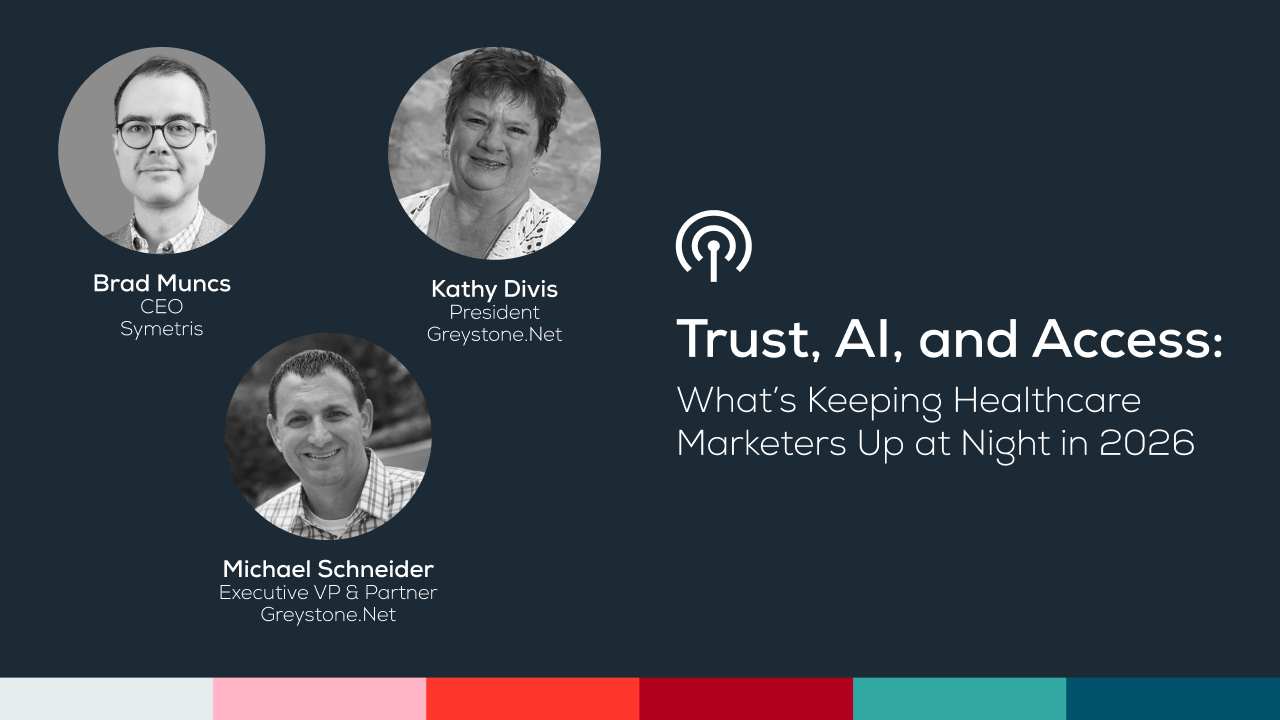
Watch on YouTube | Listen on Spotify
Kathy Divis and Mike Schneider have spent 30 years watching healthcare digital marketing reinvent itself.
Through Greystone.Net and HCIC, they saw the internet go from something health systems questioned to infrastructure nobody could imagine operating without.
When I asked Kathy and Mike about the themes shaping 2026's HCIC, I expected a long list of trends. But the conference proposals landing on their desks this year told a more specific story about what marketers are wrestling with now.
Three themes kept surfacing: trust, AI and access.
Each creates a different kind of pressure. And healthcare marketers are getting pulled into all three at the same time.
Trust has become a messier marketing problem
Healthcare has always run on trust. What has changed is the path patients take to decide whom to trust.
A patient can encounter an AI-generated answer, physician reviews, provider information, social content, and a health system website in the same research session. Marketing directly controls only a part of that experience.
Kathy connected the prominence of trust in this year’s HCIC proposals to the rise of AI. Patients have been bringing “Dr. Google” into exam rooms for years. AI accelerates that behavior because the answer arrives already synthesized and often sounds authoritative.
Mike pushed the issue one step further. Healthcare organizations now have to pay attention to what they publish and what search engines and AI systems interpret from it.
“We have to make sure not only that what we publish is correct, but that what Google and AI interpret from it is correct.”
Mike Schneider
Two pages do not need to directly contradict each other to create a problem. Slightly different descriptions, outdated provider information, inconsistent service details, or unclear terminology can give a machine enough ambiguity to generate another version of the answer.
And that interpreted answer may be the first thing the patient sees.
Content governance is becoming part of reputation management. Provider data, locations, service descriptions, credentials, scheduling instructions. The details underneath the brand increasingly shape whether an organization looks trustworthy.
Start with the inconsistencies. Where could a patient, search engine, or AI system get two different answers from your organization today?
AI is becoming too big for an “AI strategy”
AI was another theme that showed up across the HCIC proposals. That part was hardly surprising.
What was more interesting was the range of problems being grouped under those two letters.
Mike sees AI touching content creation, search, audience segmentation, call centers, analytics, everyday productivity tools and the way patients find answers. The list keeps growing.
“AI is not just one thing. It’s a hundred things.”
Mike Schneider
That makes the increasingly common question, “What’s our AI strategy?” almost too broad to be useful.
During our conversation, I compared it to asking, “What’s our computer strategy?” Once AI becomes embedded across the work, the strategy has to get more specific.
Where could AI materially improve a workflow? Who owns that use case? What data does it depend on? What could go wrong? Is it important enough to move ahead of something else already on the roadmap?
Healthcare marketers need a point of view on AI, but that point of view has to translate into choices. Search, content, analytics, patient communication and internal workflows will not all deserve the same attention at the same time.
AI gets more manageable when the conversation gets specific about the problem being solved.
Access is where marketing runs into operational reality
The third theme, access, gets at a problem healthcare marketers cannot solve on their own.
Marketing can create demand for a service line. It cannot create another cardiologist, open up a full schedule, or shorten a six-week wait for an appointment.
But patients do not experience those things as separate departments.
Kathy described what happens when someone wants care but cannot get it quickly. Even if they trust the organization, the wait creates anxiety. They start looking for other options.
“There’s a leakage problem when you have capacity issues.”
Kathy Divis
A campaign can hit its traffic and conversion goals while the patient experience breaks down one step later. The organization generated the demand, but it may not be ready to absorb it.
Marketing does not need to own clinical capacity to have a role here. It can help set expectations before a patient commits, make availability clearer, provide alternative paths when appropriate, and keep communicating during the wait.
Access also needs to enter campaign planning earlier.
If a service line already has a scheduling backlog, that should affect how aggressively it is promoted, what patients are promised, and what happens after they respond.
That is also where trust gets spent. The brand promise is only credible if the next available appointment, phone call or scheduling experience supports it.
A campaign that creates demand without a workable next step has only solved half the problem.
The old problems did not leave
Toward the end of our conversation, Mike came back to the work that rarely makes the trend headlines.
Healthcare marketing teams still have to deal with staffing, budgets, technology decisions, governance, vendors, and the day-to-day work of keeping digital programs running.
AI did not replace any of that. Neither did the renewed focus on trust or the growing pressure around access.
The new work simply landed on top of the old work.
That makes prioritization one of the harder jobs for healthcare marketing leaders in 2026. There will always be another technology to evaluate and another problem demanding attention.
I suspect that is what keeps a lot of healthcare marketers up at night. Deciding what your team can realistically take on, and what has to wait.