SHSMD 2026 Takeaway: AI Is Raising the Stakes for Health System Websites
AI is raising the stakes for health system websites. Here’s what that means for content structure, AI workflows, and patient intent.
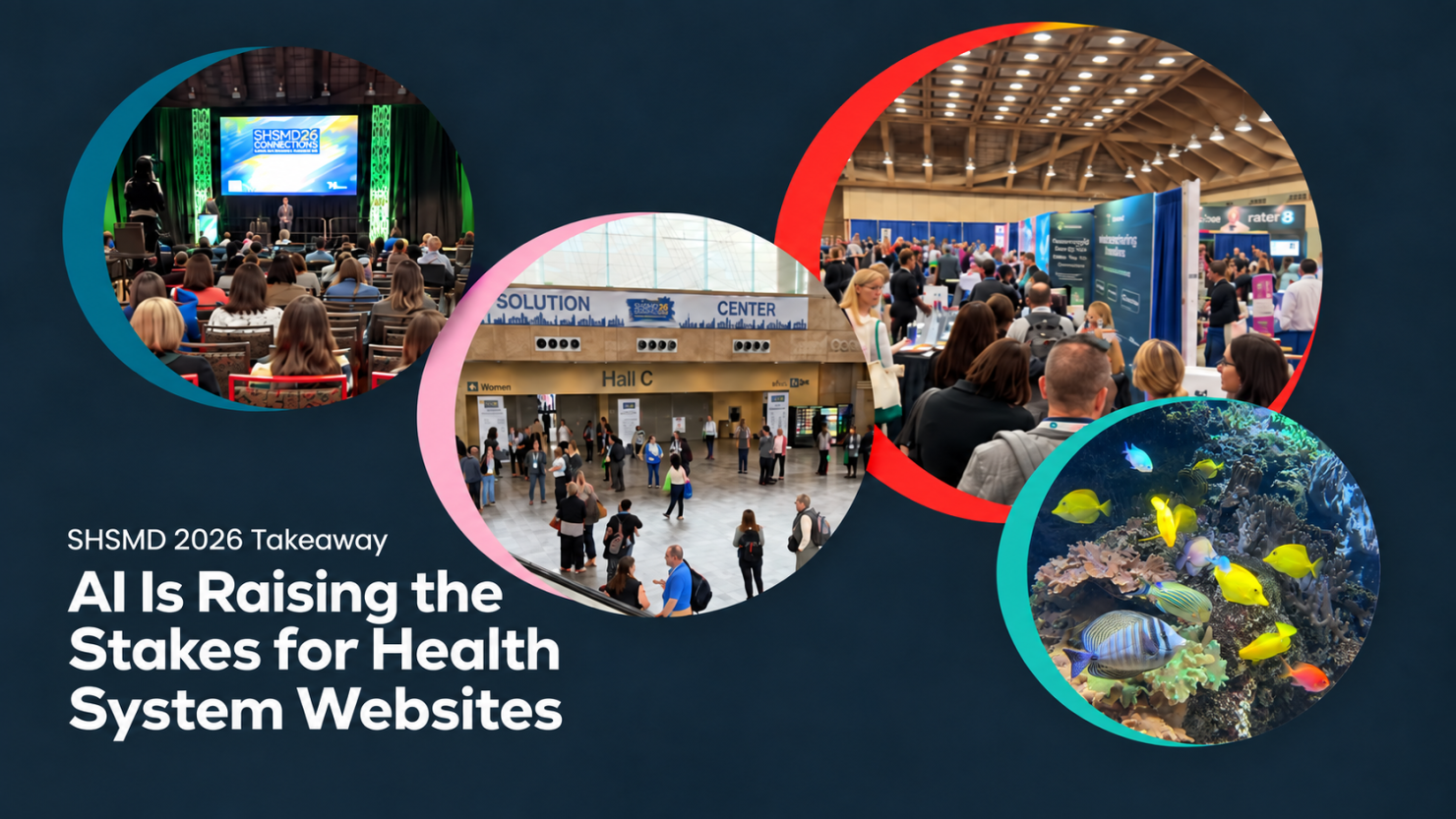
SHSMD 2026 reinforced something we’ve been seeing for a while: AI is making health system websites more important than ever.
Very different sessions converged on the idea that as AI changes how people discover healthcare information, websites are becoming more important as the main source those experiences depend on.
Patients’ expectations continue to rise, so improving digital experiences to facilitate a path towards care stays essential. But digital marketers need to see their website content beyond readability and simple SEO optimization: information now needs to be understandable to AI platforms and agents.
That puts more pressure on the information underlying each page: how content is structured and created, how relationships between elements are explicited, and how teams can learn from what patients are trying to accomplish.
Websites are increasingly becoming information infrastructure. And that is changing where healthcare marketing and digital teams need to focus on next.
The Delicate Balance Between Human Usefulness and Machine Understanding
For years, health systems have worked to make website content readable, findable, and useful for people and search engines. Now that same information needs enough context so that more sophisticated machines can interpret it correctly.
Provider profiles are a good example. Human patients can easily understand who the physician is, what they treat, where they practice, and how to take the next step. AI systems need many of those same relationships to be explicit: this physician practices at this location, treats these conditions, and is connected to these services.
When those relationships are unclear, AI systems have to infer more of the answer, which creates more room to get it wrong.
What stood out across the conference was how often this issue bubbled up at different layers of the website stack. Some discussions focused on making relationships between information more explicit so machines can understand what that content represents. Others focused on structuring content inside the CMS so providers, locations, conditions, services, and treatments can be maintained and reused more consistently.
The technologies and approaches may differ, but the operational point is the same: the quality of the relationships underneath the content is crucial.
AI Raises the Bar for Human Strategy and Content Quality
AI is already making it easier to produce more content, but not necessarily better content.
By now, AI should by now no longer just be a “pilot project”: it should be part of your everyday content workflows.
As that happens, the value of the human role moves upstream. Instead of spending most of your effort drafting every sentence, content teams need to spend more time deciding what the content should accomplish, what information actually matters, and what context an AI agent needs to produce something useful.
In healthcare, that may mean interviewing a physician or subject-matter expert, identifying the questions patients need answered, understanding how a new piece of content fits within a campaign, or defining what the call to action should be. AI can then help with drafting, reviewing, organizing, updating, and auditing that content.
That requires a different kind of digital maturity from content teams. The skill is evolving from simply writing well to being able to provide clear direction, recognizing weak output, and guiding AI toward something accurate, useful, and worth publishing.
If that strategic element is weak, AI simply lets you produce more slop faster.
Leverage Intent to Improve The Patient Journey
Healthcare teams can still use meaningful signals about what people are trying to accomplish across the digital journey, with privacy built into what they collect and connect.
Campaign context can tell you what brought someone to the site. Onsite search can show the exact words they use and the questions they are trying to answer. Scheduling behavior can show where taking the next step becomes difficult.
Tracking these signals with privacy in mind can expose useful patterns.
If people consistently arrive from a cardiology campaign and then search for insurance coverage, a small tweak to the page content could streamline their path to care. If visitors search for a service your organization provides but get no results, there may be a terminology, content, or search configuration issue. If you are heavily promoting appointments in a market where access is constrained, your digital experience and operational reality are out of sync.
Don’t simply collect more data for the sake of it. Use it to understand where people are getting stuck. Let that guide how you improve your content and overall digital journey.
What Changes When Your Website Becomes Information Infrastructure
Your website’s value increasingly depends on what sits beneath the visible page: structured information machines can understand. And your team can level up its content operations with AI to keep up without sacrificing judgment or quality.
Website strategy and KPIs can no longer stop at design, content volume, or traffic. Teams now need to think more deliberately about how information is structured, how it gets created and maintained, and how it supports the path from discovery to care.
—
Sessions that shaped these takeaways
Several SHSMD 2026 sessions helped sharpen the thinking behind this article:
- Your Website Has a New Job: Building Trust in the Age of AI Search with Martha van Berkel, Schema App
- Consumerism and Digital Engagement Post-AI: Designing the Next Generation Experience with Annie Takagi, Providence, and Kayla Robertson, Providence Swedish
- Modernizing the CMS for an AI-First Future: Preparing Healthcare Marketing for AI and Agent-Based Search with Nardeep Singh, Renown Health
- Losing Patients at the Moment of Intent: What Happens After You Earn the Click with Chris Pace, SearchStax
- From Access to Action: Turning Epic into a Growth Engine for Healthcare Marketing with Jenny Bristow and Sarah Cutcliffe, Hedy & Hopp
- Digital Experience Is Care Experience: How Health Systems Can Redesign the Front Door with Patrick Soto, ab+a advertising, and Francis Forte, Nicklaus Children’s Health System
Thanks to SHSMD and the presenters who shared practical examples of how health systems are approaching AI, content, digital experience, and patient access. These sessions came at the issues from different directions, but together they helped reinforce the larger pattern behind this article.