Your Healthcare Web Team Has Outgrown your Website
The web team’s mandate now reaches well beyond website maintenance. The operating model needs to catch up.
Watch on YouTube | Listen on Spotify
Your healthcare web team is still responsible for your website. The problem is that their job is growing far beyond it.
Scheduling and provider discovery are becoming platform decisions. Accessibility and measurement require ongoing operational attention. More of the patient experience depends on systems and decisions that the web team does not fully control.
This complexity is becoming the reality of web teams everywhere.
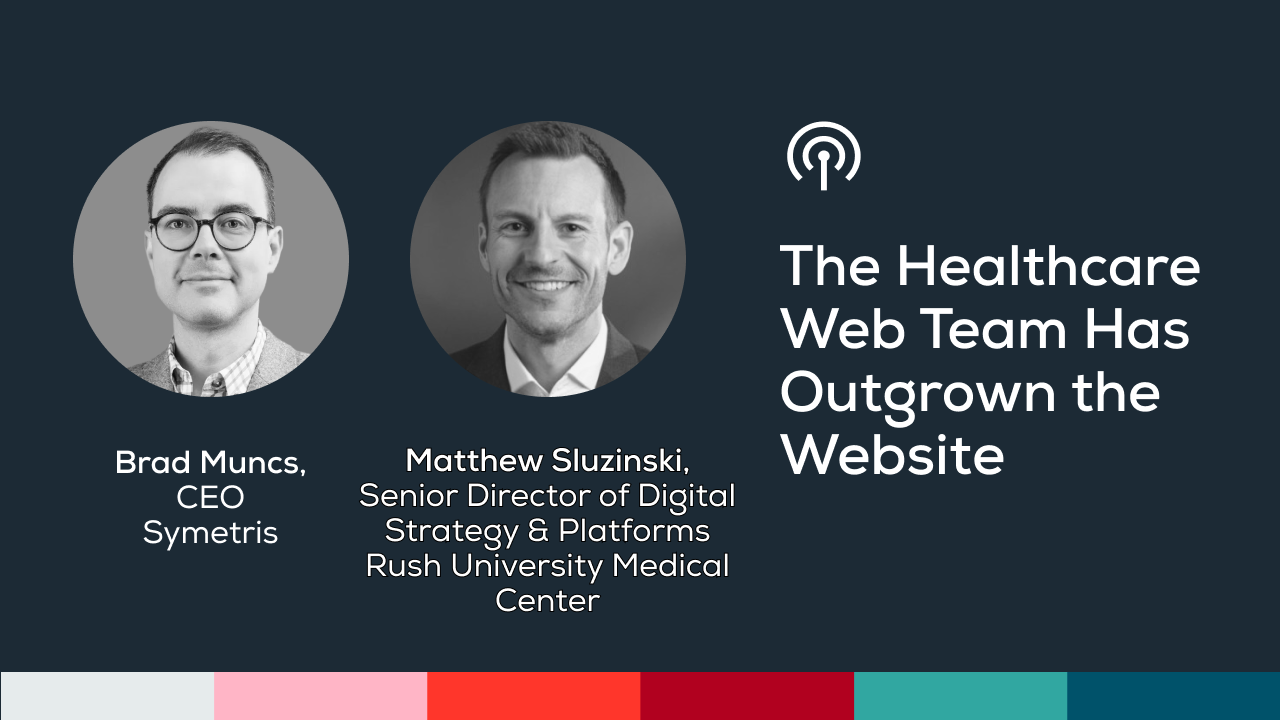
That was the thread running through my recent conversation with Matthew Sluzinski, Senior Director of Digital Strategy & Platforms at Rush University Medical Center.
Matthew described his team as evolving from a “web strategy and maintenance team” toward a “digital strategy and platforms team.” I think that distinction gets at something a lot of healthcare organizations are dealing with: the team’s mandate has expanded faster than the operating model around it.
Your web team is becoming a strategy and platforms team
Matthew's team still has to do “traditional” website work like responding to day-to-day requests while protecting capacity for platform work, accessibility, analytics, and the other responsibilities that keep the digital experience reliable.
“There’s a lot more balls in flight now and there’s a lot more demands on what we’re being asked to do. And how do we continue to adapt to that?” - Matthew Sluzinski
Provider discovery and scheduling now intersect with access strategy and platform decisions. Accessibility requires ongoing attention. Analytics has to account for privacy and data integrity.
All of that places greater demands on both the team’s time and its skill set.
The mismatch is familiar: the scope expands faster than the team’s capacity and skills.
Website problems don’t always live on the website
Some of the most important website experiences now depend on decisions that sit well beyond the website itself.
Scheduling is a good example.
To a patient, online scheduling looks like a straightforward website feature. But the experience only works if the right appointments are actually available to book, the underlying systems can support them, and the organization has aligned on how access should function.
Matthew pointed out that scheduling, provider discovery, and location discovery have all moved to a more strategic level at Rush. Improving those experiences requires coordination across teams because the front-end experience is only as good as the infrastructure behind it.
“We can’t surface online scheduling for appointments that aren’t available for online scheduling.” - Matthew Sluzinski
Once a website request starts changing how patients find or access care, it stops being a normal web ticket. It belongs on a shared roadmap.
Digital can shape the experience, but the dependencies behind it still need clear owners. With scheduling, for example, the website cannot compensate for appointments that are not available to book.
That is where governance matters. It makes ownership and decision rights explicit before design or development moves ahead. We go deeper into that model in Who Really Owns Your Hospital’s Website?
The work nobody sees still needs an owner
Some of the responsibilities taking up more of healthcare digital teams' time are also the easiest to overlook.
Matthew pointed to accessibility, measurement integrity, and listings as examples. None of them necessarily produce the kind of visible change that comes with a redesign or a new patient-facing feature. But they require ongoing attention, specialized skills, and clear ownership.
The problem is that success in these areas often looks like nothing happened.
We talk constantly about technical debt. Digital teams can accumulate governance debt too. Skip the foundational work long enough and risk quietly compounds until something breaks.
“They just expect it to be right. And we expect it to be right. But there’s a lot of work that goes into maintaining that kind of information.” - Matthew Sluzinski
Healthcare marketing and digital leaders need a support model for this work: clear ownership, a regular cadence, and protected capacity so foundational responsibilities are managed consistently instead of reactively.
The team can’t keep absorbing more work
As digital’s scope expands, the existing team cannot simply keep taking on more.
Matthew is responding by separating the work more clearly between platforms and operations on one side, and strategy and experience on the other. The exact structure matters less than making different types of work visible enough to resource and manage properly.
More headcount is not the only answer. Some of the work requires people already on the team to develop new skills or move into different kinds of work.
Matthew described “learning how to learn” as an important meta-skill. The work will keep changing faster than most organizations can hire around it. Digital leaders need to understand where existing people can grow, what work no longer deserves the same investment, and where outside support can close a real capability gap.
“We’re never going to be able to hire incrementally to keep up with where the market’s changing or where we need to put resources.” - Matthew Sluzinski
For digital leaders, the practical step is to look at where the team’s time is actually going, which skills need to evolve, and whether the current structure still matches the work.
Leadership has to deliberately protect capacity for platform operations, strategic work, and capability building. Otherwise the service queue will keep consuming it.
Your web team’s scope is already changing. The question is whether your operating model can catch up.