AI in Healthcare Marketing: A Grounded Approach to Real Adoption
A pragmatic look at how healthcare marketing teams can adopt AI responsibly—starting with workflows, governance, and patient expectations rather than hype or wholesale transformation.
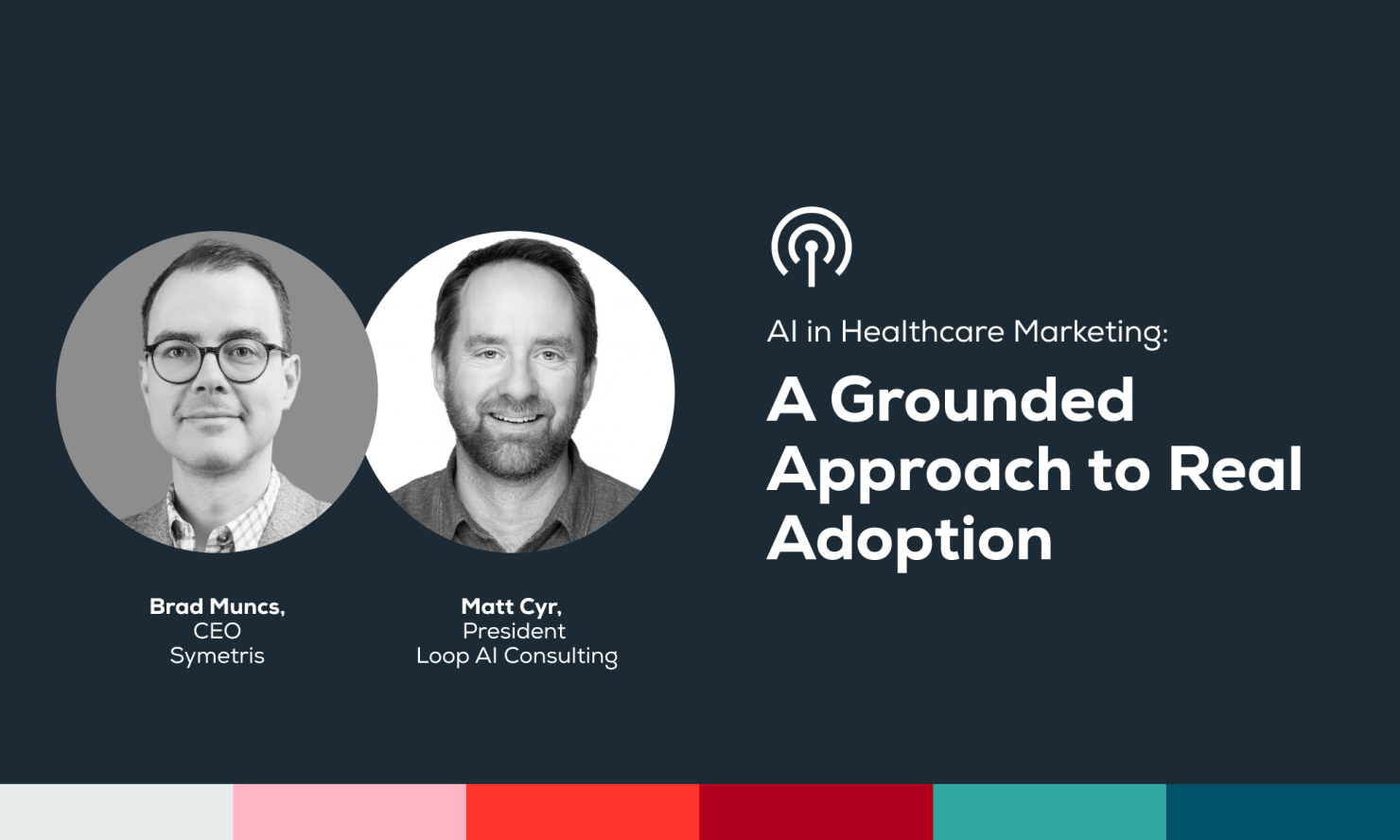
Watch on YouTube | Listen on Spotify
When a CMO tells the marketing team to “use AI more,” the directive usually comes with good intentions. Efficiency. Innovation. Staying competitive.
The friction shows up later, when that vision meets day-to-day reality: legacy workflows, uneven data, risk-averse governance, and teams who are unsure where AI fits into their actual jobs.
That gap between ambition and execution is where most healthcare marketing teams are sitting right now.
In a recent podcast conversation, I spoke with Matt Cyr, president of Loop AI Consulting and a longtime operator across both healthcare systems and agencies. Rather than debating whether AI matters, we focused on a more practical question: how healthcare marketers can start using it in ways that are useful, responsible, and sustainable.
Watch the full Podcast Episode on Youtube and Spotify
AI Works Best With Humans Paying Attention
“AI can benefit humanity, but only if humans are in the loop”.
Matt Cyr, Loop AI Consulting
That framing from Matt set the tone for the entire conversation. Despite the headlines, AI is not showing up as a replacement for marketing teams or agencies. Its early value is far more operational.
Across healthcare organizations, the most consistent gains are coming from AI handling work that slows teams down: repetitive analysis, manual reporting, early-stage synthesis of large data sets. When used well, it reduces friction and helps teams move faster toward informed decisions.
What it does not do is remove the need for judgment.
AI still produces errors, misreads context, and occasionally fabricates confidence where none should exist. Anything that touches patients, brand trust, or clinical credibility still requires human review. Matt described AI as a way to get the work started faster, not a way to skip it entirely.
“It’s like putting the ball on the tee,” he said. “The team still has to swing.”
Why AI Adoption Breaks Down Inside Health Systems
One of the recurring frustrations Matt sees is the disconnect between how AI is marketed and how healthcare organizations actually operate.
Vendors often present AI as a clean overlay that instantly improves performance. Inside health systems, the reality is messier. Teams are stretched. Processes have grown organically over time. Data lives in multiple systems and does not always agree with itself.
Introducing AI into that environment without addressing those conditions does not create efficiency. It accelerates existing problems.
“When workflows are broken, AI tends to automate the dysfunction.”
Matt Cyr, Loop.ai
The barriers to adoption are rarely technical. They show up in people, trust, governance, and readiness. Teams worry about job security. Leaders worry about compliance. Everyone worries about risk.
Progress starts when those concerns are acknowledged instead of bypassed.
The way forward is simpler: start small and focus narrowly.
Small, Focused Use Cases Create Real Momentum
The most successful AI initiatives Matt described did not start with sweeping transformations. They started with narrow problems that were already costing teams time and attention.
Common entry points included:
- Automating recurring reporting and data compilation
- Identifying missing or inconsistent metadata across large websites
- Summarizing patterns in patient behavior or campaign performance
- Producing first-draft internal documentation from existing materials
In one example, a healthcare agency was spending hours each week assembling client reports. Strategists pulled data from multiple sources, summarized trends, and rewrote similar narratives month after month.
By introducing AI to handle the repetitive components, compiling prior reports, generating draft summaries, flagging anomalies, the team reduced reporting time by roughly 40%. The strategists spent that reclaimed time on interpretation and recommendations, where their expertise actually mattered.
“It’s those boring, unsexy things that actually move the needle.”
Matt Cyr, Loop AI Consulting
Patients Are Already Using AI. Your Website Needs to Catch Up
While much of the AI conversation focuses on internal teams, patient behavior is shifting just as quickly.
According to a study by Press Ganey, 43% of healthcare consumers are already using AI tools to research medical conditions, 42% to explore treatment options. At the same time, many healthcare websites are seeing over 30% declines in organic traffic, alongside longer and more conversational search queries.
The pattern is not uniform across markets or service lines, but the direction is clear. People are getting used to systems that interpret intent rather than keywords.
That shift has implications for healthcare websites.
Patients increasingly expect on-site search and navigation to behave more intelligently. They want systems that understand what they are trying to accomplish, not just what they typed.
From our work at Symetris, this often points to practical improvements rather than wholesale redesigns:
- On-site search that handles natural language queries
- Cleaner content structure and metadata
- Fewer encyclopedic condition pages, paired with clearer articulation of clinical expertise and care philosophy
- Clear governance around any AI-powered patient-facing tools
As expectations evolve, websites cannot remain static repositories of information. They need to function as responsive entry points into care.
“People are starting to expect on-site search to behave more like AI: to understand what they mean, not just the exact words they type.”
Brad Muncs, Symetris
A Practical Starting Point for Healthcare Marketers
There is no single roadmap that fits every organization. That said, a few patterns consistently reduce friction early on.
Identify internal champions
Look for team members who are curious and thoughtful about AI. Give them room to experiment within defined boundaries.
- Audit existing workflows
Start with tasks that are repetitive, manual, and internal-facing. These are often the lowest-risk opportunities to test value.
- Make AI a shared conversation
Avoid isolating AI knowledge within a single role or team. Education and transparency reduce anxiety and build trust.
- Establish governance early
Especially for anything patient-facing. Clear rules create confidence, not constraint.
- Pay attention to patient behavior
Search patterns, content engagement, and navigation data often reveal where expectations are shifting first.
Progress tends to follow clarity, not ambition.
Don’t Wait for the Perfect Moment
Healthcare marketing teams occupy an interesting position. Few organizations will collapse if marketing adopts AI slowly, but the opportunity is ripe for the taking.
Teams that wait for complete alignment, flawless data, or a fully defined strategy often find themselves reacting later under more pressure. Teams that start thoughtfully, with modest experiments and clear boundaries, build institutional confidence over time.
“Don’t let the perfect be the enemy of the good. Get started today. Do something small. Then keep going”.
Matt Cyr, Loop AI Consulting
AI is not asking healthcare marketers to move faster than they are comfortable with. It’s quietly rewarding those who are willing to learn in public, adjust as they go, and take responsibility for how technology shows up in the patient experience.
The real question is not whether AI belongs in healthcare marketing.
It is whether your organization is shaping that adoption deliberately, or inheriting it by default.