Hospital Websites Aren’t Dead: They’re Operating Under Higher Stakes
Hospital websites aren’t disappearing. They’re operating under higher stakes. Why governance, structure, and friction now matter more than traffic volume.
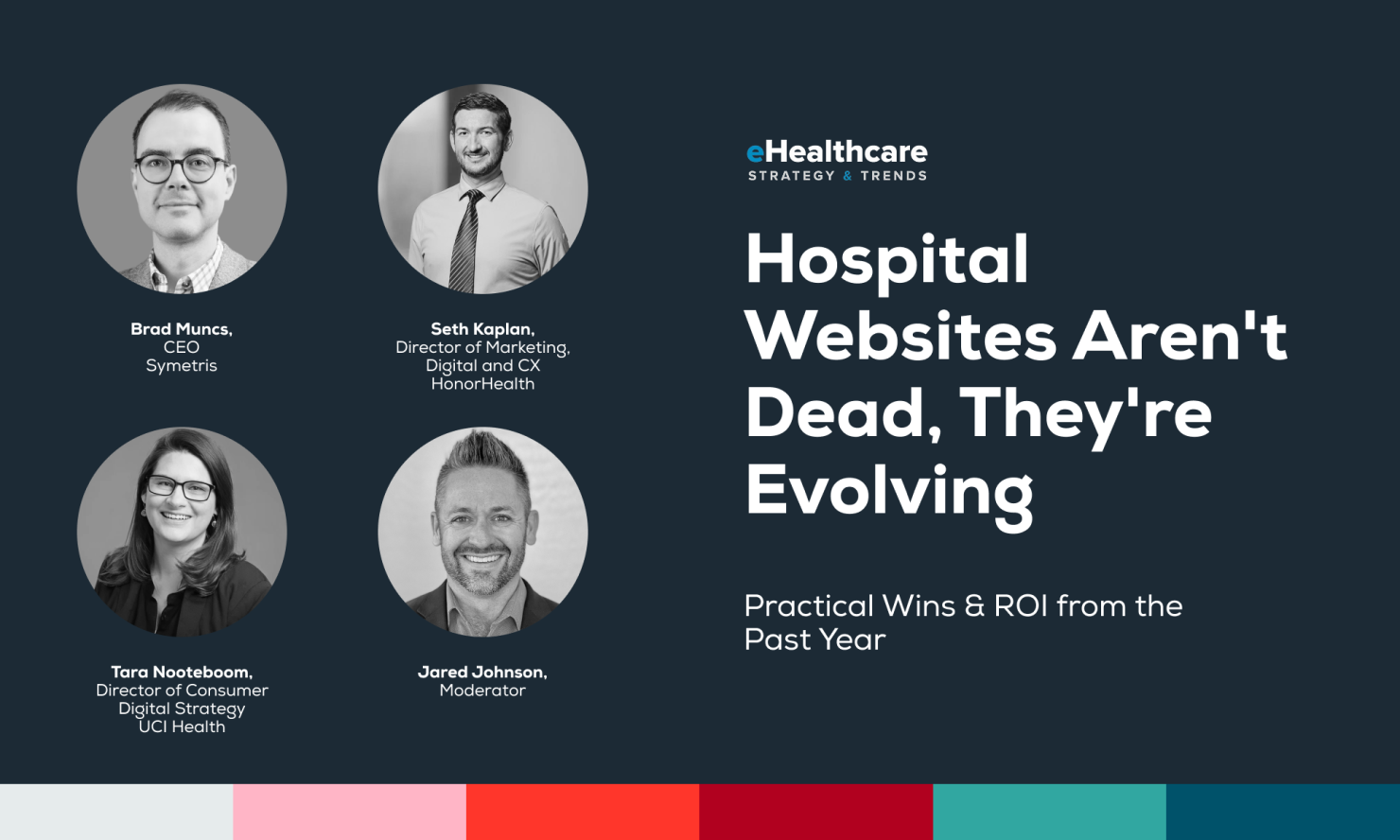
Insights from a conversation with Tara Nooteboom and Seth Kaplan
“For all this rumor that hospital websites are dead, the website is more a part of my conversations now than it has been before.”
— Tara Nooteboom
That line came early in a recent eHealthcare Strategies & Trends webinar where I joined Tara Nooteboom from UCI Health and Seth Kaplan from HonorHealth to discuss where hospital websites are heading.
Across very different health systems, operating under different constraints and priorities, the same pattern surfaced again and again: The job of the hospital website has changed. Its importance has not.
Traffic Is Down. Intent Is Up.
AI summaries and search engines now answer early-stage questions before patients ever reach a hospital site.
That means fewer casual visits. Fewer symptom searches landing on your domain.
But the visitors who do arrive are closer to a decision.
Across healthcare websites, a large portion of traffic now comes from existing patients. Another meaningful segment comes from prospective patients who already know what type of care they need. They are not browsing. They are evaluating and preparing to act.
“The website isn’t an encyclopedia anymore. It’s a decision environment.”
— Brad Muncs
That shift changes the mandate.
If a prospective patient lands on your site and cannot quickly find a provider, compare options, or understand what differentiates your care, they will move on.
Less traffic does not mean less importance. It means higher stakes per visit.
The Real Work Is Removing Friction
One of the clearest areas of alignment across the conversation was this: the most impactful improvements are rarely massive redesigns.
They are focused changes in high-intent areas:
- Provider search
- Scheduling flows
- Navigation clarity
- Integration with booking systems
Seth summarized it bluntly:
“There’s really no need to visit the site unless you’re needing to make a transaction.”
— Seth Kaplan
When those transactional paths break, patients feel it immediately.
When they work well, the effect is measurable. Higher booking completion. Fewer drop-offs in scheduling. Reduced call center pressure because patients can complete tasks online.
At HonorHealth, that meant getting unglamorous about data. Their team rebuilt physician tagging so subspecialties actually surface correctly in search. An orthopedic surgeon who focuses on knees should appear when someone searches knees, not just orthopedics. It sounds obvious. In practice, it requires disciplined data governance.
They also implemented PHI-compliant tracking after privacy restrictions forced many systems to turn analytics off entirely. You cannot prioritize friction reduction if you are flying blind. Getting measurement back safely was not a marketing upgrade. It was table stakes.
The emphasis was not on chasing volume. It was on making core actions easier and more reliable.
Sometimes the highest impact change is very tactical. UCI Health added a centralized department phone number page after repeated patient feedback that numbers were hard to find. Not a redesign. Not a personalization engine. A phone number page. In high-intent moments, the fix is rarely glamorous.
Incremental improvements in the right places consistently outperform cosmetic overhauls.
Governance Is the Hidden Lever
Another theme surfaced repeatedly during the webinar: governance.
Not in a bureaucratic sense. In an operational one.
When multiple service lines compete for homepage space, when requests arrive without clear prioritization, when ownership is shared but accountability is undefined, the website slows down.
Committees feel collaborative. In practice, however, they often stall progress.
The teams that move fastest have clarity:
- Clear ownership of the website as a product
- Structured intake for requests
- Data-informed prioritization
If one page drives meaningful traffic and another drives very little, that informs attention and investment.
Without that discipline, technical debt accumulates. Publishing cycles stretch. And eventually, the organization pays through expensive resets.
Governance is not overhead. It is how you protect speed.
Accuracy Over Volume in the Age of AI
AI has changed the content equation.
Generic medical information is widely accessible elsewhere. Patients can get definitions and symptom lists instantly.
What they can’t get from an AI summary is your differentiation. Your providers. Your approach. Your outcomes.
At UCI Health, differentiation meant exposing what makes them structurally different. Their redesign moved away from rigid page hierarchies and instead connected services, providers, and clinical trials through structured relationships. Clinical trials are now searchable alongside physicians and programs, not buried in a research silo.
That is not content expansion. That is structural clarity. And in an AI environment, structure determines visibility.
If content is outdated, inconsistent, or vague, trust erodes quickly. And in healthcare, trust is the baseline.
In today’s world of AI slop, restraint becomes strategic. Fewer pages. Clearer positioning. Content that builds trust.
Trust is built through clarity and reliability, not scale.
ROI Is Operational, Not Just Marketing
When budgets tighten, website investment comes under scrutiny.
The mistake many teams make is presenting ROI through marketing metrics alone.
Executives care about revenue, cost, and risk.
Website improvements tie directly to all three:
- Revenue enablement when digital engagement connects cleanly to bookings.
- Cost avoidance when patients can self-schedule instead of calling.
- Risk mitigation when the platform evolves steadily instead of stagnating and requiring disruptive rebuilds.
The conversation is not about having a nicer website. It’s about managing a critical digital asset responsibly.
2026: Higher Stakes, Less Room for Error
Different health systems. Same pattern.
Web traffic may decline. Expectations do not.
When visits carry higher intent, every broken search result, every outdated profile, every hidden phone number carries more weight. There is less room for friction. Less room for governance drift. Less room for “we’ll fix it in the redesign.”
The website is no longer a publishing channel. It is an access mechanism.
The teams that treat it like infrastructure will compound trust and performance quietly over time.
The ones that treat it like a campaign will eventually pay for it.