Healthcare’s Personalization Problem Is Mostly Self-Inflicted
Healthcare didn’t lose personalization. It lost confidence. A practical look at how trust, consent, and small steps unlock better patient experiences.
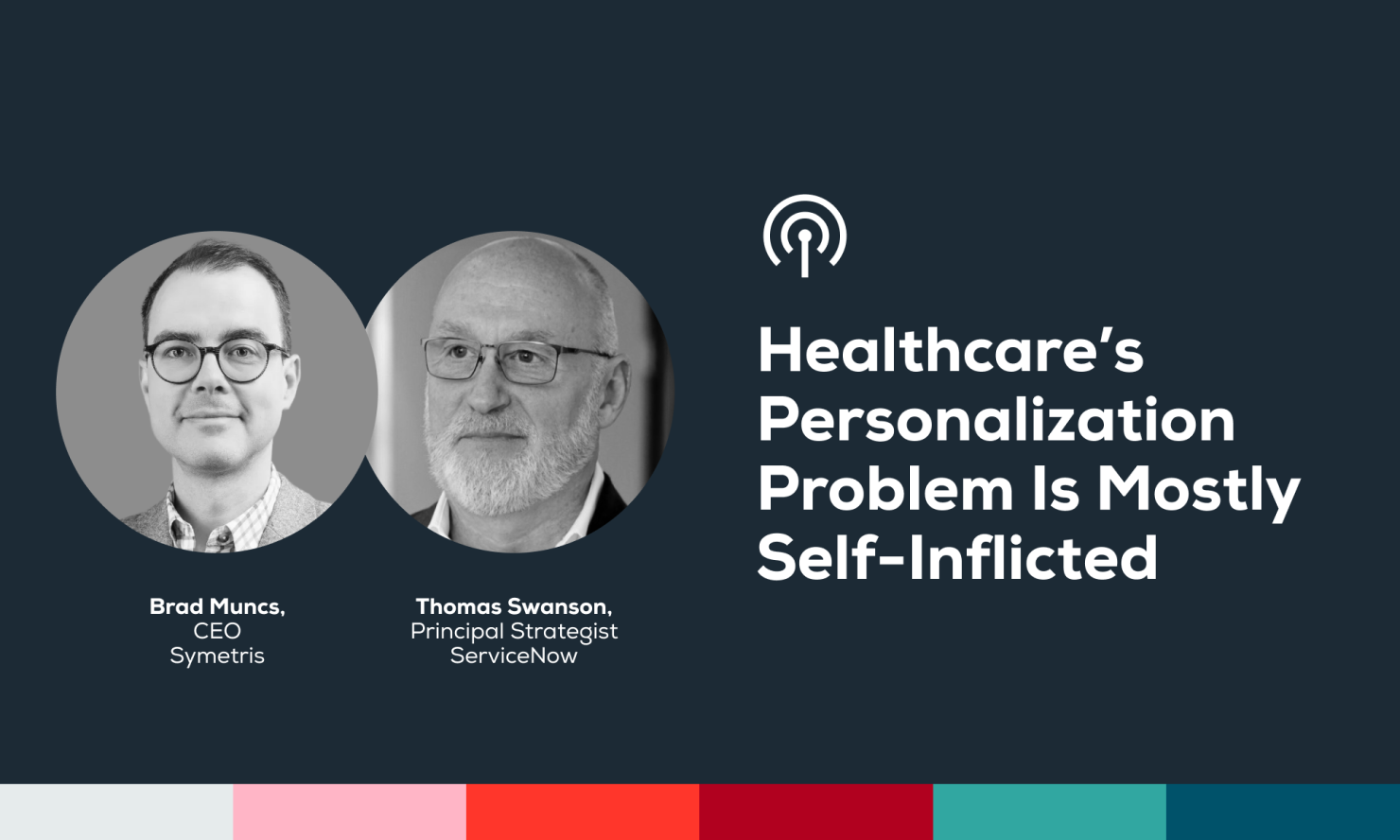
Watch on YouTube | Listen on Spotify
Over the last few years, healthcare marketing teams stopped personalizing their digital experiences. Most of them didn't have to.
The shift didn’t come out of nowhere. Lawsuits, evolving interpretations of HIPAA, and the fallout from the Google Analytics and Meta Pixel rulings forced organizations to re-examine how they were collecting and using data. Legal teams stepped in, often decisively. In many cases, tracking tools were removed altogether, along with much of the visibility marketers had relied on.
The reaction made sense. The conclusion didn’t. Many teams landed on: Maybe we can’t really do personalization anymore.
Tomas Swanson spent nearly a decade at Adobe, helping healthcare and life sciences organizations implement Adobe Experience Manager in environments where HIPAA compliance was non-negotiable. Now a Principal Strategist at ServiceNow, he's watched the same pattern play out across dozens of organizations. In a recent conversation, we unpacked where that caution crossed the line into avoidance.
Healthcare didn’t lose the ability to personalize digital experiences. It lost confidence in how to do it safely.
The patient didn’t lower expectations. The system did.
While healthcare organizations were pulling back, the rest of the digital world kept moving forward.
People still expect their bank to anticipate needs. They still book travel in minutes. They still receive recommendations that feel relevant without asking for them.
Then they land on a hospital website and the experience resets.
Generic content. No continuity. No sense that the system understands why they are there.
“Thinking of them as consumers is actually a really important psychological shift.”
- Thomas Swanson
That shift is uncomfortable in healthcare. It pushes against decades of system-centered thinking. But it reflects how people behave.
Patients arrive informed. They compare options. They make decisions.
And they expect the experience to reflect that context.
The mistake: treating personalization like a switch
Most organizations don’t reject personalization. They frame it in a way that makes it unworkable.
It becomes binary.
Either nothing is personalized, or everything needs to be fully integrated, one-to-one, and connected to clinical systems.
Compliance concerns stack up. Governance becomes unclear. Integration becomes a prerequisite for action. The scope grows faster than the ability to execute.
So nothing ships. Or everything gets shut down to stay safe.
Different paths. Same result.
Personalization is a trust ladder
“It is kind of a continuum of getting from being anonymous to that one-to-one personalization.”
- Thomas Swanson
At the beginning, you are working with very little. Location. Basic context. Enough to make the experience feel less generic.
Then you move into voluntary signals. Someone downloads a guide. Signs up for updates. Engages with a specific topic. They are giving you something, and in return they expect relevance.
Over time, patterns start to form. You understand what they are looking for and where they might be in their journey. You are still outside the clinical record, but you are no longer guessing.
Only later do you reach authenticated experiences, where deeper personalization becomes appropriate and expected.
Seen this way, personalization is not a capability you unlock.
It is something you earn.
Consent is not a gate
One of the more useful reframes from the conversation was how to think about consent.
It is often treated as a checkpoint. Either you have it or you don’t.
Treating consent as a one-time gate is convenient. It’s also what makes most personalization programs unusable.
In practice, it behaves more like any other piece of data. It is specific. Contextual. Limited to a particular use.
Instead of asking whether personalization is allowed, you start asking what has actually been permitted, in what context, and for how long.
That level of precision changes the conversation with legal. It also forces discipline. You are no longer trying to unlock everything. You are designing for a specific interaction.
Where healthcare teams get stuck
Two patterns tend to emerge in organizations trying to navigate this space.
The first is paralysis. After the regulatory shifts, some teams concluded that any meaningful use of behavioral data was too risky. So they stopped. No experimentation, no iteration, and very little progress.
The second is overengineering. Instead of stopping, other teams go in the opposite direction. They design large-scale personalization programs that depend on fully integrated platforms, unified data layers, and perfect alignment across departments.
Those initiatives tend to stall under their own weight.
Both approaches avoid the same thing: starting with something small enough to test, but meaningful enough to matter.
Start with content
When organizations do move forward, they often look for a platform. But the more immediate opportunity is simpler: it’s in the content.
As Tom put it, the starting point is what you are actually delivering to the user. The follow-up email that reflects a real action. The page that adapts to context. The nudge that appears at the right moment.
None of this requires a full transformation.
It requires clarity about what would actually be useful
One audience, one action, one pilot
If personalization feels complex, it’s often because the scope is too broad.
A more effective approach is to narrow it down.
Pick one audience. Define one action. Identify the minimum data needed to support it. Then set boundaries around how that data is used and for how long.
From there, run a pilot.
Learn from it. Adjust. Expand.
This is not a new idea, but it is consistently overlooked. Precision about what you are trying to achieve, and what data you actually need, is what makes progress possible.
If you want to go deeper into how teams are navigating this in practice, you can see the full conversation here: Listen on Spotify and Watch on YouTube
Healthcare personalization isn’t blocked in the way many teams assume. It stalls when organizations try to solve everything at once. Or avoid it altogether.
The problem isn’t that healthcare can’t personalize. It’s trying to skip the part where trust gets built.