NESHCo 2026 Made One Thing Clear: Healthcare Websites Are Under More Pressure Than Ever
NESHCo 2026 made one thing clear: healthcare websites are being asked to do more while marketing teams have less room for wasted work. That changes how teams need to prioritize, qualify, and right-size website decisions.
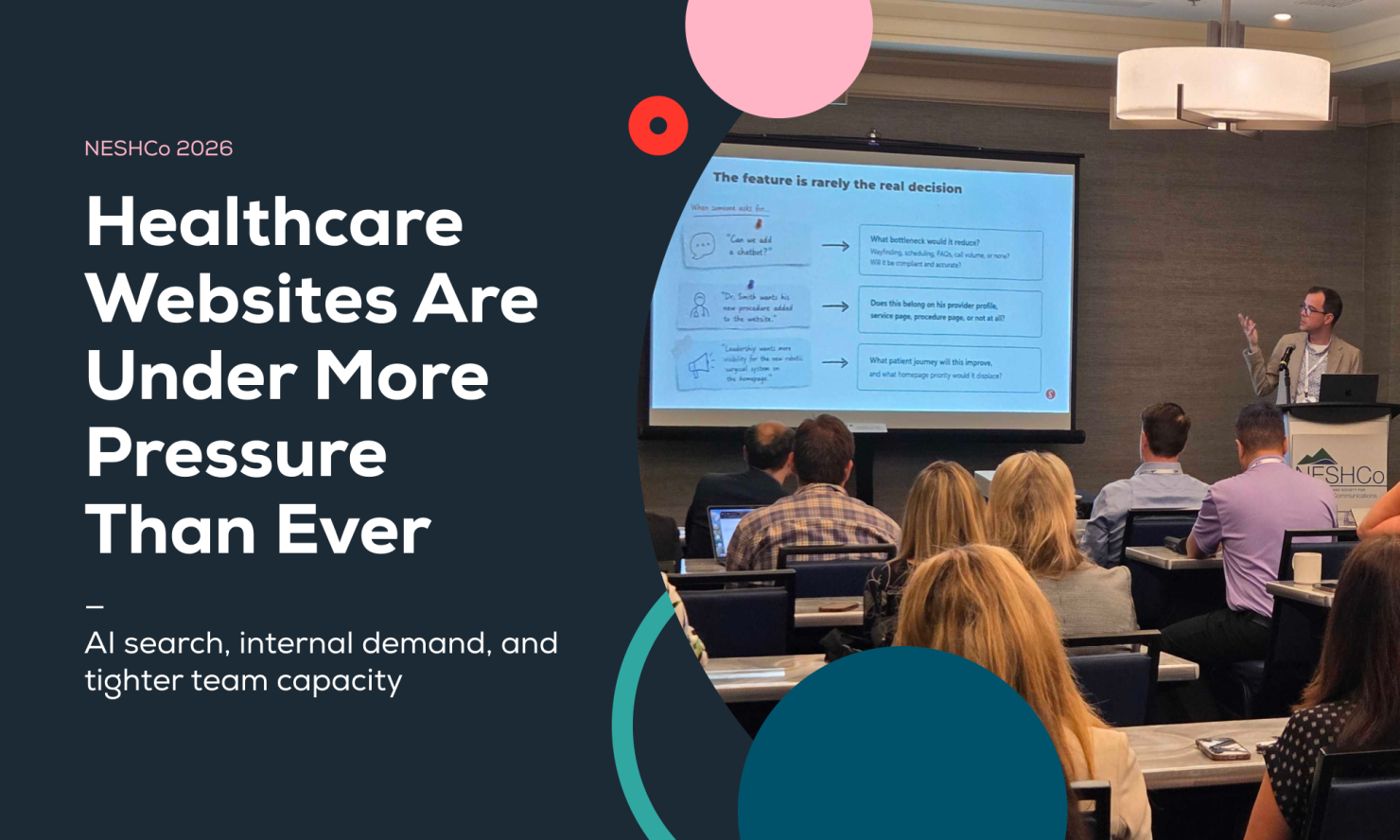
AI search, internal demand, and tighter team capacity are changing how healthcare marketers need to decide what gets built, structured, and maintained.
NESHCo 2026 surfaced two pressures that healthcare marketers now have to manage at the same time.
On one side, teams are being asked to do more with less. Across sessions and conversations, the same themes surfaced: tighter budgets, smaller teams, and greater pressure to focus effort where it matters most.
On the other side, the website is being asked to do more.
It still supports patients, campaigns, service lines, and stakeholders, but now it also serves as source material for AI search, chatbots, and other digital experiences.
It’s a combination that raises the stakes.
When the website carries more weight and the team behind it has less spare capacity, every decision matters more. What gets built, what gets structured, what gets maintained, and what gets delayed all create downstream consequences.
When the website does more, every decision carries more downstream impact
One of the clearest website-related insights from NESHCo came through Aha Media's CRISP framework: the website is no longer just a place people visit. It is becoming a source layer that AI and other systems rely on.
A service line page now has to do more than support a single visit or conversion path. It may also inform search results, AI-generated answers, chatbot responses, and the way AI tools interpret relationships between services, providers, locations, and next steps.
If a provider, clinic, or service is described differently across the website, AI may fill in the gaps itself. Sometimes that means the wrong relationship gets inferred. Sometimes it means the right relationship is too weak or inconsistent to be trusted. The same is true for condition content, physician bios, FAQs, PDFs, and location pages.
When content becomes source material, small decisions travel farther.
A vague heading is hard to interpret. A buried answer is difficult to reuse. A service described three different ways across the site creates confusion for patients and weak signals for machines. A five-year-old PDF might be parsed by AI and surface outdated information.
That does not mean every page needs to become an AI project.
It means the website needs to be treated less like a collection of pages and more like a governed system of answers, entities, relationships, and next steps.
The website isn’t the only front door anymore, but it is increasingly the foundation behind every other door.
Website strategy has to move upstream
Prioritization too often gets determined by healthcare marketers' inboxes. The workday gets shaped by urgency, volume, stakeholder pressure, and whoever has the clearest ask.
But if website decisions now carry more downstream impact, strategy has to happen before requests enter the queue.
Several NESHCo sessions pointed to the same reality: focus has to be established early, before work reaches production.
That means starting with strategy before tactics. The team needs to know what the organization is trying to achieve, which service lines or patient actions matter most right now, and where the real tradeoffs are. It also means knowing who needs to be heard before the decision gets made.
This is also where listening matters.
Strong strategy starts with people before numbers. Leadership, providers, service line teams, frontline staff, donors, patients, and marketing all see different parts of the system. If those inputs are skipped, the website team risks solving the visible request instead of the real problem.
Qualification is how teams protect capacity and reduce risk
Strategy gives you direction. Qualification is how you test whether a specific initiative deserves time, budget, review effort, and long-term ownership.
That is where qualification matters.
Before an initiative becomes work, teams need to test it against six things:
- Does this support a real organizational or service-line priority?
- Will it make a patient action easier?
- Is the service line ready to absorb the demand it might create?
- What budget, staff time, clinical review, compliance review, and maintenance will it require?
- Why does it matter now?
- And who owns the content, accuracy, and performance after launch?
A request can be reasonable and still not be ready. It might support a valid goal with no one willing to own it. Or sound urgent while more important waits. The maintenance trail alone can make a visibility win not worth it.
That is the point of qualification: not to slow everything down, but to make sure the work is valuable enough, clear enough, and owned enough before it consumes capacity.
A website intake form can help here. Not because the form is magic, but because it forces the requester to clarify the purpose, owner, timing, and expected outcome before the work reaches the team. That small amount of friction usually reduces the total volume of requests, while improving the quality of the ones that make it through.
Not every request needs a yes or no
Once a request has been qualified, teams have several ways to respond depending on the opportunity, the level of risk, available resources, and how well the work aligns with organizational priorities.
In many cases, the best path combines multiple approaches. For example, a team might shrink the scope of an initiative while also piloting it to validate demand and impact before making a larger investment. The goal is not to force every request into a single category, but to choose the combination of actions that creates the most value while protecting capacity and reducing unnecessary risk.
The most common responses include:
- Build it because the value is clear.
- Pilot it because the idea has potential, but the risk is still too high.
- Shrink it because the full version is more than the goal requires.
- Redirect it because the request is valid, but the proposed solution is wrong.
- Park it because the timing, ownership, or strategic fit is not there yet.
These are strategic responses to qualified opportunities, not project-management statuses used to track work after a decision has already been made.
In a higher-pressure environment, good judgment often means choosing the smallest responsible version of the work.
Better decision frameworks create room for the work that matters next
The pressure on healthcare websites is not going away.
AI search, fragmented discovery, patient expectations, service line priorities, and internal demand will keep pushing the website to do more. At the same time, many healthcare marketing teams will keep working within real limits: budget, headcount, review capacity, technology constraints, and organizational attention.
That is why better decision frameworks matter.
They help teams protect capacity for the work that creates the most value: improving patient findability across changing search experiences, strengthening service line visibility, reducing friction in key patient journeys, maintaining trustworthy source content, and making website investments that remain useful as channels and technologies evolve.
As demands continue to outpace capacity, the advantage will come from making deliberate choices about where time, budget, and attention are invested.
The organizations that do this well will be better positioned to respond to change without losing focus on the outcomes that matter most.
NESHCo sessions that informed this article
This article was shaped by several NESHCo 2026 sessions and conversations, including Ahava Leibtag’s CRISP framework for future-ready content, David Tyrell’s session on operating through “absoludicrous” times at MIT Health, Laila Waggoner’s session on finding focus and alignment when everything feels fragmented, Dan Dunlop’s session on listening and change management, and the Mass General Brigham team’s discussion of alignment and storytelling across a large marketing organization.