Your Healthcare Website Has an Expiration Date. Most Organizations Plan Too Late.
Healthcare websites have a shelf life. Learn to spot operational fatigue early and plan your next rebuild before the organization starts pushing a dull knife.

The day your new website launches, the clock starts ticking.
Not because the design will eventually look tired. Not because the CMS will need updates. Not because another health system will launch something shinier.
A healthcare website reaches its expiration date when it can no longer keep up with what the organization needs from it.
The site may still load. Pages may still publish. Forms may still submit. From the outside, everything may look fine.
But inside the marketing team, people know.
A new service line needs a section, and it takes months instead of days. A campaign needs a focused patient journey, and the content team starts sweating. Editors begin saying no to reasonable requests because the site cannot flex without custom work.
Every improvement requires a workaround, a meeting, a ticket, and a compromise.
That is not just an old website. That is operational fatigue.
Design does not unlock budget. Operational drag does.
A dated design can make the brand feel behind and give internal teams a reason to question the website.
But design alone rarely makes the case for a major rebuild.
Healthcare leaders are not waiting around to fund prettier websites. They are weighing capital expenses, compliance risk, service line priorities, staffing constraints, technology roadmaps, and a long list of competing needs.
So if the case for a rebuild is “the site looks old,” the conversation is already weak.
The better case is this: the website is no longer responding to the pace of the organization.
If operations want to promote a priority service line, can marketing move quickly? If a campaign needs a focused patient journey, can the website support it? If the organization changes how it talks about access, care models, locations, providers, or specialties, can the content structure adapt?
When the answer keeps coming back as “yes, but it will take a while,” the website is already telling you something.
A dull knife still cuts. That is the problem.
A website is like a good kitchen knife.
When it is sharp, the work feels easier. You move with control. You can be precise. You do not think much about the tool because the tool does its job.
When the knife gets dull, it does not stop cutting. It just makes you work harder. You apply more pressure. You compensate. You tell yourself it is still fine because, technically, dinner is still getting made.
That is the danger with an aging website. It does not fail dramatically at first. It asks more from the people using it.
You see it when a service line campaign needs to launch quickly, but the landing page template cannot support the journey. The team can publish the page, technically. But the CTA is wrong, the provider content is buried, the form requires IT help, and analytics will need to be patched together later.
Nobody calls that a platform failure.
They just absorb it. Again.
At some point, the team starts protecting the tool instead of using the tool.
That is when the expiration date is closer than people think.
Assume five years. Then manage the exceptions.
Every organization is different. A small regional provider, a large academic medical center, and a multi-state health system will not age their websites at the same speed.
Still, healthcare marketers need a working assumption.
Start with five years.
Five years is not a prediction. It is a planning assumption.
If you launch a new healthcare website and assume it should last indefinitely, you are setting yourself up for a reactive rebuild later. Treating it as a five-year asset creates a healthier conversation from the beginning.
You are not saying, “We will definitely rebuild in year five.”
You are saying, “We will manage this as a strategic asset with a known lifecycle.”
That distinction matters. A five-year assumption gives the CMO, CTO, digital team, content team, and finance leaders a shared clock. It makes the next rebuild less surprising. It also creates room to inspect, sharpen, extend, or replace the tool before everyone is frustrated.
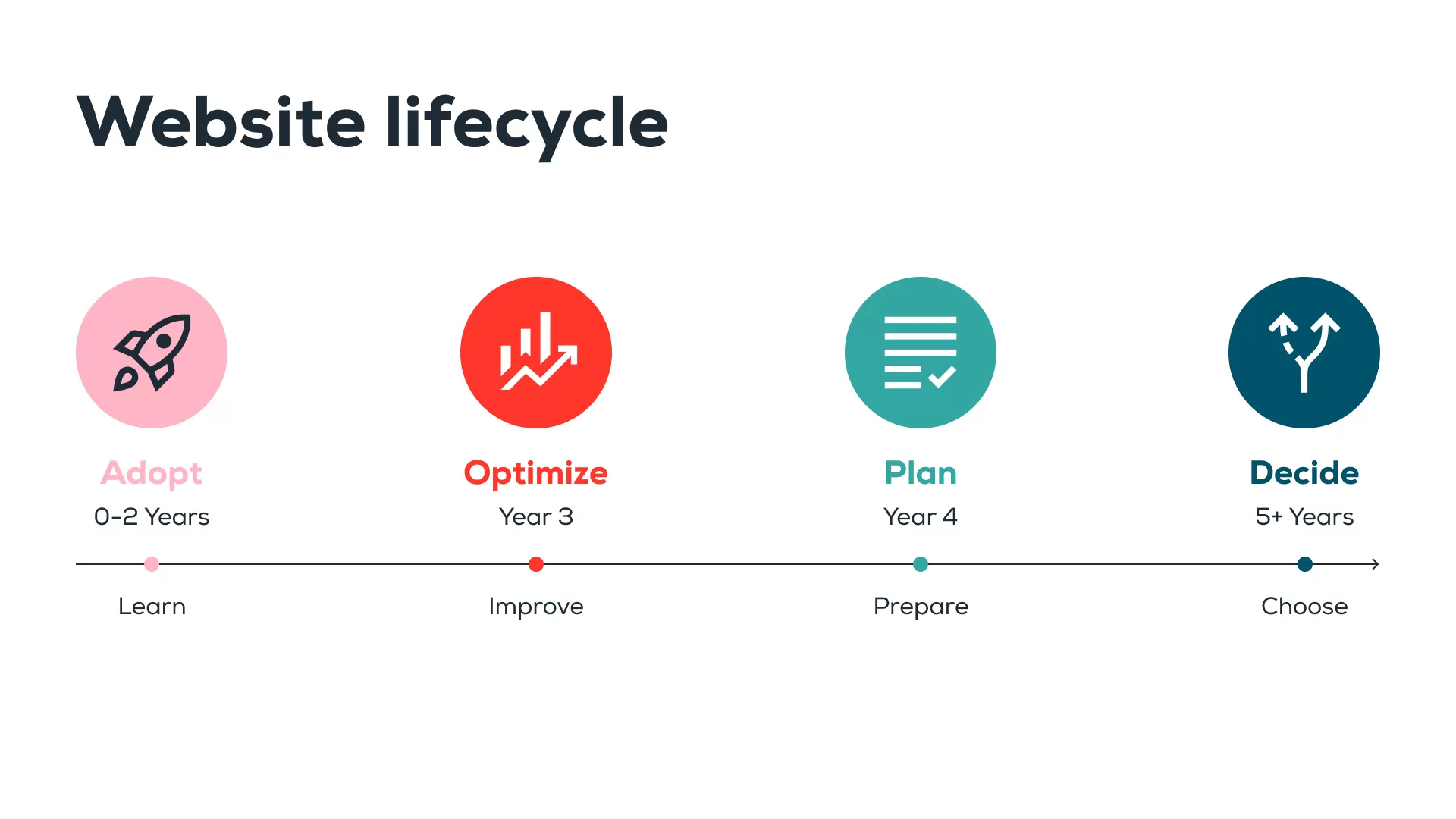
The rough pattern looks like this:
- Years one and two: learn what the site can do under real organizational pressure.
- Year three: run at cruising speed, but watch for drag.
- Year four: start the serious conversation with your CTO.
- Year five: rebuild, refresh, or deliberately extend.
The right time to start feels too early.
In healthcare, waiting is expensive.
Procurement takes time. Budget planning takes time. Stakeholder alignment takes time. Compliance review takes time. IT input takes time. Content inventory takes time. Governance decisions take time. Agency selection takes time. Platform decisions take time.
This is why “we will deal with it when it gets bad” is not a strategy.
By the time the site feels obviously expired, the organization may still be one or two years away from replacing it properly. That is how teams get trapped. The site is old enough to slow the organization down, but not broken enough to create urgency. Everyone agrees something needs to happen, but nobody has budget, scope, alignment, or time.
A smarter CMO starts earlier.
Before replacing the knife, see if it can be sharpened.
Not every aging website needs a full rebuild.
Sometimes the platform is fine, but the team needs training. Sometimes the CMS is flexible, but the configuration is poor. Sometimes governance has become heavier than the technology requires. Sometimes the content strategy is unclear, so every request feels harder than it should. Sometimes the organization changed, but the website never caught up.
That is why investigation matters.
Start with the people closest to the work: content editors, service line marketers, IT, compliance, and your agency. Then review the evidence. Look at ticket patterns, publishing timelines, campaign launches, request bottlenecks, and the places where people have quietly built workarounds.
If everyone can get on the same page about what needs to be sharpened, you may not need a rebuild yet.
But when every conversation turns into finger-pointing, that is a different signal. The process blames the platform. The platform blames governance. Governance blames compliance. Compliance blames risk. At that point, you are no longer looking at a simple maintenance issue.
You are looking at a system that may no longer fit the work.
The worst time to plan a rebuild is when everyone finally agrees you need one.
A smart website strategy does not wait for the platform to become embarrassing. It watches for fatigue. It measures drag. It listens to editors. It studies launch cycles. It asks whether the website is still helping the organization move.
Your website has an expiration date. You may not know the exact day. You may be able to extend it. You may be able to sharpen the tool and get more life from it.
But pretending the date does not exist is how teams end up pushing harder with a dull knife.
Get your Checklist